Tri-tip roast · 2.6 lb / 1.2 kg · Offset stick burner
Tri-tip over oak, one hundred and five minutes, sliced two ways
A 1.2 kg tri-tip smoked at 120°C over oak for ninety minutes, seared ninety seconds a side and rested twenty-five minutes. A cheap cut that eats like an expensive one, on one condition: you have to slice it in two directions.
- Cook date14 Oct 2026
- Published19 Oct 2026
- Raw weight2.6 lb / 1.2 kg
- WoodOak
- CookerOffset stick burner

Cook timeline
- 16:30 Tri-tip on, fat side up, over the firebox end Salt 1.5% and coarse pepper, applied 3 hours ahead Pit120°C Internal6°C +0m
- 17:00 Nothing done One oak split at the start is the only wood for this cook Pit120°C Internal26°C +30m
- 17:40 Moved to the cooler end of the chamber The point end runs 8°C ahead of the wide end on a tri-tip Pit121°C Internal42°C +1h10
- 18:00 Checked every 5 minutes now From 49°C to 54°C is about twelve minutes on this cut Pit122°C Internal49°C +1h30
- 18:15 Pulled and seared 90 seconds a side over the firebox Sear adds about 3°C; account for it before you pull Pit122°C Internal54°C +1h45
- 18:15 Rested 25 minutes, then sliced in two directions Cut the roast in two at the seam, then slice each half against its own grain Pit122°C Internal54°C +1h45
The two grains, and finding the seam
A tri-tip is triangular and has two muscles fused along a visible seam of connective tissue. On one side the grain runs across the short axis; on the other it runs lengthwise towards the point. Sliced in one direction only, half the roast is tough no matter how well it was cooked.
The seam runs from the middle of the wide end towards the point, and it is usually obvious once you look for a line of paler tissue. Cut the roast in half along it first, then treat each half as its own roast.
| Half | Grain direction | Slice angle | Thickness |
|---|---|---|---|
| Wide half | Across the short axis | 90° to the fiber | 8 mm |
| Point half | Lengthwise towards the point | 45° bias to the fiber | 8 mm |
| Both | — | Always against the fiber | Never with it |
Why there is no margin at 9% fat
A ribeye at 28% fat forgives five degrees either way. A tri-tip at 9% fat does not forgive anything: from 56°C the muscle fibers contract enough to start squeezing out moisture, and by 62°C the slice is visibly dry on the board.
This is why tri-tip is a fast cook rather than a slow one. There is no collagen to convert, so time at temperature buys you nothing — it only costs moisture. Ninety minutes at 120°C to bring it to 49°C, then twelve more minutes to 54°C, and off.
| Pull at | After the sear | Slice | Verdict |
|---|---|---|---|
| 48°C | 51°C | Very red | Rare, fine if you like it |
| 51°C | 54°C | Deep pink | Best |
| 54°C (this cook) | 56°C | Pink, juicy | Good |
| 58°C | 60°C | Pale pink, drying | Overcooked |
| 62°C | 64°C | Grey | Ruined |
The Santa Maria rub, and what it is not
The classic Santa Maria seasoning is salt, black pepper and garlic salt, and that is all. It is not a barbecue rub: no sugar, no paprika, no chilli. The flavour comes from the oak smoke and the beef, and adding more to it obscures both.
Salt at 1.5% by weight and coarse pepper at 0.8%, applied three hours ahead at room temperature. Garlic salt is traditional but it doubles the sodium, so if you use it, cut the plain salt by half.
- Salt 1.5%, coarse black pepper 0.8%, three hours ahead
- No sugar — it burns during the sear and turns bitter
- Garlic salt if you want it, but halve the plain salt
- Oak only; mesquite is too strong for a 9% fat cut
Searing, resting and the sandwich that comes after
Ninety seconds a side over the firebox opening, where the grate is hottest, gives a crust without cooking the centre past 56°C. Move it with tongs, never a fork, and do not walk away — the window is short and the fire is right there.
Rest twenty-five minutes, uncovered, on a plate. Then the two-direction slice. Served with salsa, grilled spring onions and a warm tortilla, this is the best value beef on the ledger. Sandwiches the next day with the thin slices and a horseradish cream are almost better.
- Sear 90 seconds a side over the hottest part of the grate
- Rest 25 minutes uncovered on a plate
- Slice 8 mm, both halves against their own grain
- Serve with salsa, spring onions and tortillas; horseradish cream on sandwiches
Cross-section notes
A tri-tip is a triangular muscle with two distinct grain directions meeting along a seam that runs roughly from the wide end to the point. The cross-section shows it clearly: on one side the fibers run across the short axis, on the other they run lengthwise and are visibly coarser.
- Stall
- 0°C
- Wrap method
- No wrap (bare bark)
- Wrapped at
- never wrapped
- Pulled at
- 54°C
- Rest
- 25m
- Score
- 4.5/5
Verdict: One hour forty-five minutes at 120°C then a hard sear. Tri-tip is 9% fat, which means there is no margin: two degrees past 56°C and it starts to read dry. The whole cook is about slicing it correctly, which takes thirty seconds to learn.
Adjacent entries
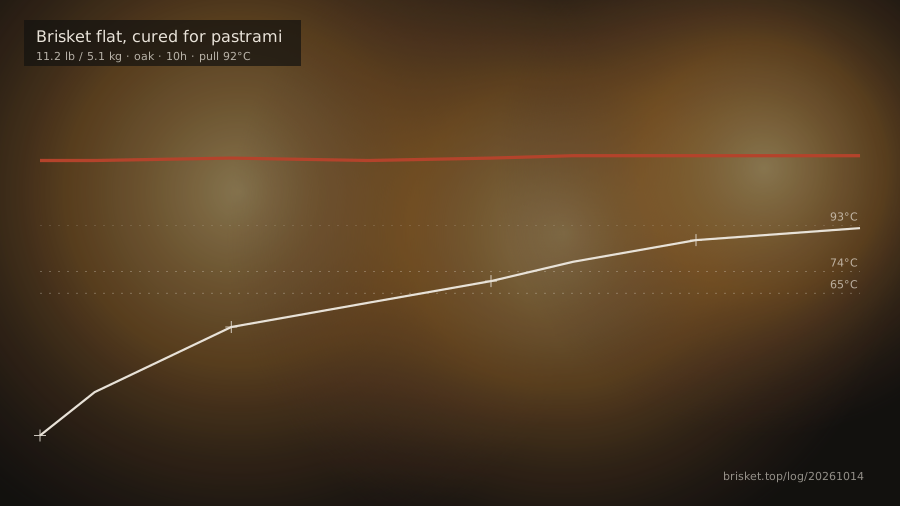
 14 Oct 2026
Brisket flat, cured for pastrami
Oak
Insulated cabinet
11.2 lb / 5.1 kg
Deep pink to the centre, peppery crust, slices paper thin4.6/5
14 Oct 2026
Brisket flat, cured for pastrami
Oak
Insulated cabinet
11.2 lb / 5.1 kg
Deep pink to the centre, peppery crust, slices paper thin4.6/5
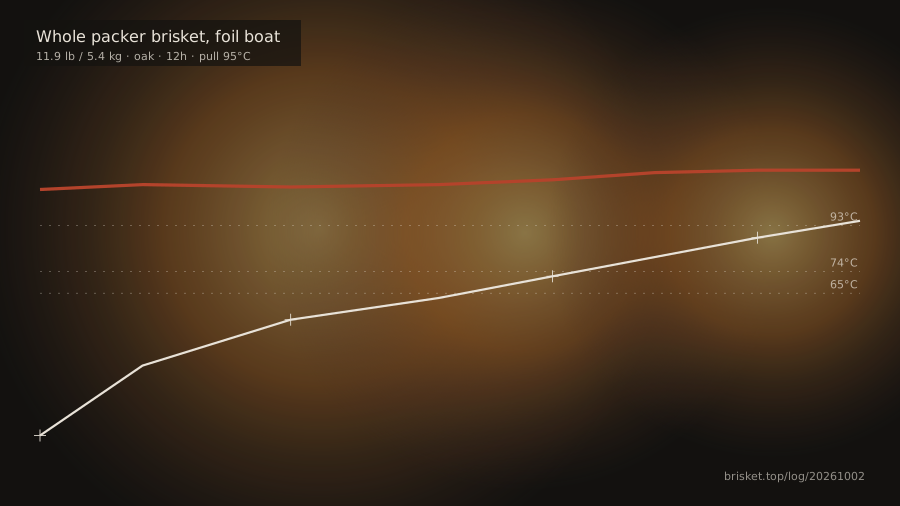
 2 Oct 2026
Whole packer brisket, foil boat
Oak
Offset stick burner
11.9 lb / 5.4 kg
Crispest bark of any wrap method tried this year4.7/5
2 Oct 2026
Whole packer brisket, foil boat
Oak
Offset stick burner
11.9 lb / 5.4 kg
Crispest bark of any wrap method tried this year4.7/5