Tomahawk ribeye · 3.5 lb / 1.6 kg · Ceramic kamado
Tomahawk ribeye, reverse seared over mesquite
A 1.6 kg bone-in ribeye smoked at 110°C for fifty-five minutes, then finished over wide-open vents at 280°C for eight minutes. Pink from edge to edge with a two-millimetre crust and no grey band anywhere.
- Cook date13 Sep 2026
- Published18 Sep 2026
- Raw weight3.5 lb / 1.6 kg
- WoodMesquite
- CookerCeramic kamado
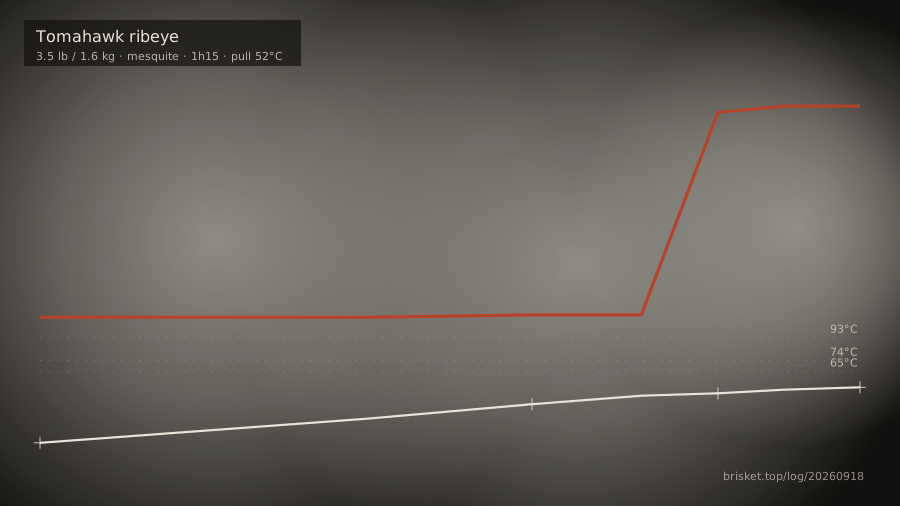
Cook timeline
- 17:30 Tomahawk on, bone to the side, over the deflector Dry brined 24 hours, uncovered; surface should be tacky, not wet Pit110°C Internal6°C +0m
- 18:00 One mesquite chunk in Mesquite at low chamber temperature is a completely different ingredient from mesquite on a hot grill Pit110°C Internal26°C +30m
- 18:15 Checked the fat cap; beginning to soften The fat cap is the heat shield on a tomahawk — keep it on top Pit112°C Internal38°C +45m
- 18:25 Removed the steak and opened the vents The kamado goes from 112°C to 280°C in seven minutes with the vents wide Pit112°C Internal45°C +55m
- 18:32 Steak back on, directly over the coals Ninety seconds, rotate 45°, ninety seconds, flip, repeat Pit280°C Internal47°C +1h02
- 18:38 Second side done, bone end held over the coals for 20 seconds The bone is a handle and it does not need cooking Pit285°C Internal50°C +1h08
- 18:45 Pulled at 52°C, rested 20 minutes on a warm plate Rest on a plate, not a board — a board wicks the juices away Pit285°C Internal52°C +1h15
Why reverse searing works on a steak this thick
A 1.6 kg tomahawk is about 6 cm thick at the eye. Grilled directly, the outside reaches 90°C while the centre is still at 30°C, and by the time the centre is at 52°C there is a 1 cm grey band on each side that is fully well done. That is a third of the steak.
Reverse searing brings the whole steak to 45°C slowly and evenly at 110°C, then applies high heat for a short time to build the crust. The centre only climbs seven more degrees during the sear, so the grey band never has time to form.
| Method | Time | Grey band | Centre |
|---|---|---|---|
| Direct grill | 14 min | 10 mm each side | 52°C, uneven |
| Reverse sear (this cook) | 75 min | none | 52°C, uniform |
| Oven then pan | 60 min | 4 mm | 52°C, nearly uniform |
| Sous vide then torch | 180 min | 2 mm | 52°C, uniform |
The dry brine and the fat cap
Salt at 1.5% by weight, on all faces, twenty-four hours ahead and uncovered in the fridge. A tomahawk has a large surface area and a thick fat cap, so a longer dry brine than you would give a ribeye is not just possible but necessary.
The fat cap goes up, always. It shields the eye from the direct heat of the deflector and it renders slowly into the crust. If you flip a tomahawk fat-cap-down at any point in the low stage you are cooking the best part of it into the drip tray.
- Salt 1.5% on every face, 24 hours, uncovered
- Coarse pepper only after the cook, not before — it burns at 280°C
- Fat cap up throughout the low stage
- No oil, no butter, nothing on the surface before the sear
The sear, and getting the kamado hot fast
A kamado will go from 110°C to 280°C in seven minutes if you open both vents fully and leave the lid open for the first two. That is the advantage of ceramic over steel: the thermal mass is already there and it is just a matter of air.
Ninety seconds a quadrant, rotated 45° each time, gives a crosshatch and a 2 mm crust in six minutes. Then hold the bone end over the coals for twenty seconds to colour it, and get the steak off.
| Step | Time | Grate temperature | Effect |
|---|---|---|---|
| Quadrant 1 | 90 s | 280°C | Crust starts, marks form |
| Rotate 45° | 90 s | 280°C | Crosshatch |
| Flip | 90 s | 285°C | Second side crust |
| Rotate 45° | 90 s | 285°C | Crosshatch, internal +5°C |
Resting, carving and the bone
Twenty minutes on a warmed plate, not a board and not foil. Foil traps steam and softens the crust you just built; a board draws the juices out of the meat. A plate with a slight well collects them so you can pour them back.
Carve the eye off the bone in one piece, then slice against the grain at 1 cm. The spinalis — the cap muscle on the outer edge — should be cut separately and served first, because it is the best part and it should not be mixed in with the rest.
- Rest 20 minutes on a warm plate, uncovered
- Cut the eye off the bone whole, then slice against the grain at 1 cm
- The spinalis cap is sliced separately and served first
- The bone goes into a stock pot with the trim; 1.6 kg of tomahawk yields about 200 g of trim
Cross-section notes
The reverse sear exists to eliminate the grey band, and this cross-section shows it worked: uniform pink from the crust inward with no grey transition zone, a 2 mm dark crust, and the spinalis muscle on the outer edge visibly more marbled than the longissimus in the centre.
- Stall
- 0°C
- Wrap method
- No wrap (bare bark)
- Wrapped at
- never wrapped
- Pulled at
- 52°C
- Rest
- 20m
- Score
- 4.9/5
Verdict: A 75-minute cook for a 1.6 kg steak, and 55 of those minutes are at 110°C doing nothing visible. The reward is a steak that is pink to within 2 mm of the crust, which no straight grilling method achieves on a piece this thick.
Adjacent entries
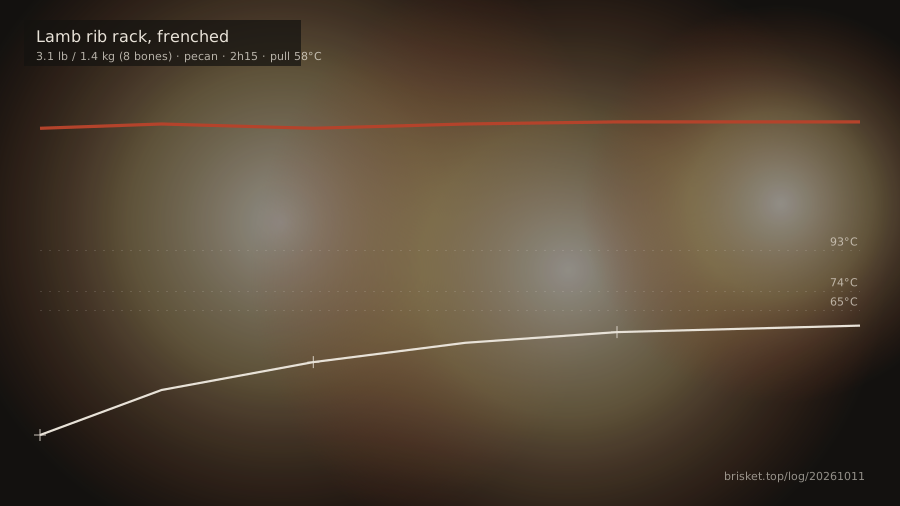 8 Oct 2026
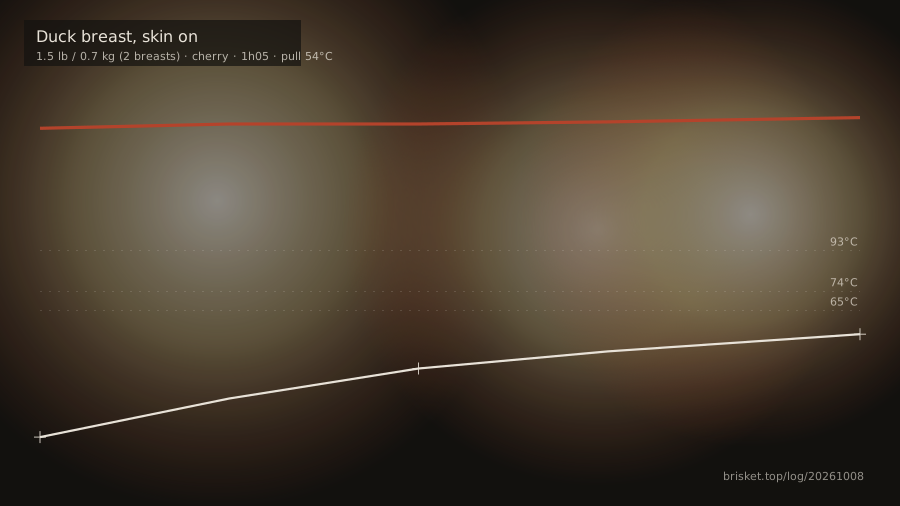
Duck breast, skin on
Cherry
Ceramic kamado
1.5 lb / 0.7 kg (2 breasts)
Skin rendered but not crisp; the fat layer was still 5 mm thick4.1/5
8 Oct 2026
Duck breast, skin on
Cherry
Ceramic kamado
1.5 lb / 0.7 kg (2 breasts)
Skin rendered but not crisp; the fat layer was still 5 mm thick4.1/5
 16 Sep 2026
Bone-in lamb shoulder
Pecan
Ceramic kamado
5.1 lb / 2.3 kg
Pulled into long strands, more savoury than pork and less sweet4.7/5
16 Sep 2026
Bone-in lamb shoulder
Pecan
Ceramic kamado
5.1 lb / 2.3 kg
Pulled into long strands, more savoury than pork and less sweet4.7/5