Whole packer brisket, dry brined 48 hours · 13.0 lb / 5.9 kg · Gravity-fed charcoal
Brisket dry brined 48 hours at 0.8% salt
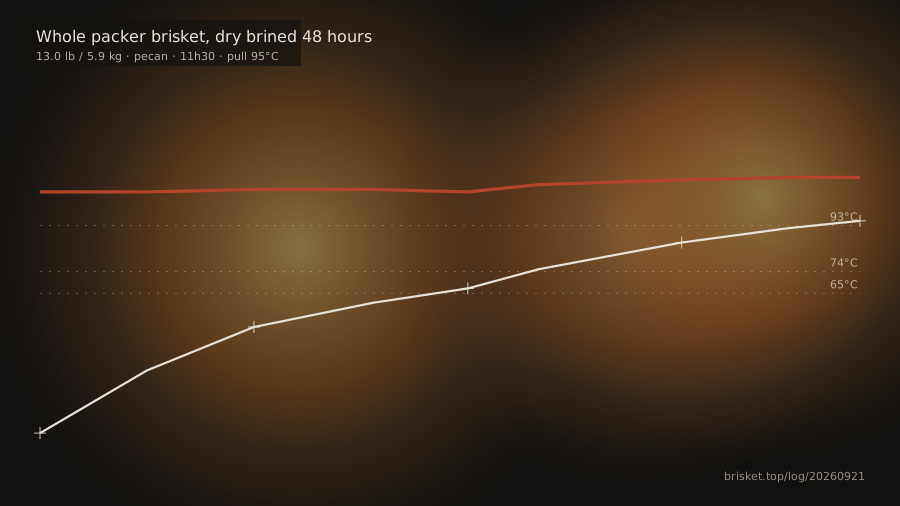
A 5.9 kg packer salted at 0.8% of its trimmed weight and left uncovered in the fridge for two days, then cooked over pecan at 107°C for eleven and a half hours and rested for four. The palest bark on the ledger and the best flat.
- Cook date17 Sep 2026
- Published21 Sep 2026
- Raw weight13.0 lb / 5.9 kg
- WoodPecan
- CookerGravity-fed charcoal
Cook timeline
- 03:20 Brisket on, fat side down, 8 kg of lump loaded in the chute Gravity feeder lit from the bottom; no further fuel work for seven hours Pit107°C Internal7°C +0m
- 04:50 Nothing done, lid closed The whole point of a gravity-fed cabinet is that the first three hours need no input Pit107°C Internal33°C +1h30
- 06:20 Two pecan splits added to the ash pan Pecan gives hickory flavour at about 60% of the intensity Pit108°C Internal51°C +3h
- 08:00 Stall starting, held everything steady 0.8% salt means less surface moisture to evaporate, so the stall arrives later and is shallower Pit108°C Internal61°C +4h40
- 09:20 Deep stall, 90 minutes without movement Do not open the door; that is what makes this stage take four hours instead of two Pit107°C Internal67°C +6h
- 10:20 Wrapped in peach paper, chamber raised to 110°C Raising the chamber after the wrap is safe; raising it before is not Pit110°C Internal75°C +7h
- 12:20 Checked the paper for pooling fat A paper wrap that pools fat steams the bark; if it does, open it and re-wrap Pit112°C Internal86°C +9h
- 13:50 Probe tested every 20 minutes At 0.8% salt the tenderness window is wider, which is one of the reasons to brine this way Pit113°C Internal92°C +10h30
- 14:50 Pulled, vented 10 minutes, wrapped in towels into a cooler Four hours in the cooler to follow Pit113°C Internal95°C +11h30
Why 0.8% and not the usual 1.2%
Most brisket rubs land between 1.2% and 1.5% salt by weight of the meat. That is a good number if you are slicing and eating it straight. It is the wrong number if you are cooking the flat to 95°C, because salt concentrates as water leaves, and the thin end of the flat loses proportionally more water than the thick end. The result is a slice that tastes correctly seasoned at the thick end and too salty at the thin.
Dropping to 0.8% and doubling the time from 24 to 48 hours fixes that without losing the brine's effect. The salt still gets to the centre of a 5.9 kg packer in two days; what changes is how much of it is sitting on the surface at hour ten.
| Salt | Brine time | Flat at the thin end | Bark colour |
|---|---|---|---|
| 1.4% | 12 h | Noticeably salty, dries first | Near black |
| 1.2% | 14 h | Salty at the last 4 cm | Very dark |
| 0.8% (this cook) | 48 h | Seasoned evenly to the tip | Medium mahogany |
| 0.6% | 48 h | Slightly under-seasoned | Medium mahogany |
Running a gravity-fed cabinet
Eight kilograms of lump charcoal in the chute ran the pit for seven hours with no attention. The chamber sat between 107°C and 108°C from minute zero to hour seven, which is tighter than any stick burner manages. The trade is that you are not adding wood smoke during that window either — the two pecan splits at hour three were the only wood that went in.
For a brisket that is a reasonable trade. The smoke character here comes from the two splits and from the charcoal, and it is lighter than an all-wood cook. If you want a heavier smoke line, load less charcoal and feed more splits through the ash door.
- 8 kg lump charcoal in the chute, lit from the bottom with a weed burner
- Two pecan splits at hour 3, 45 cm long, added through the ash pan door
- Intake set to one third open for the entire cook, never adjusted
- Chamber swing over 11.5 hours: 6°C total, from 107°C to 113°C
The four-hour rest
This is the step that low-salt brisket demands. After a 48-hour brine the meat is holding less free water on its surface and more inside the fibres, and it needs time off the heat for that to even out. Four hours in a dry cooler brought the internal temperature from 95°C down to 49°C.
Below about 54°C, fat starts to set and the slice feels firmer on the tongue. Serving at 49°C is not a hot serve. If that matters, hold it in a 65°C oven instead of a cooler for the last hour — the texture is slightly less relaxed, the plate is hot.
| Minutes off the pit | Internal | Slice texture |
|---|---|---|
| 0 | 95°C | Soft, steam visible, slice tears slightly |
| 90 | 72°C | Best slice — clean cut, juice on the board |
| 150 | 61°C | Firmer, easier to cut thin |
| 240 | 49°C | Fat set, texture firmer again |
Slicing the packer after a long rest
A four-hour rest changes the order of the slicing job. The point and the flat separate more cleanly after a long rest because the fat between them has set; run the knife along that seam first, then slice the flat across its grain at 6 mm and cube or slice the point separately.
Going through the whole packer in one pass looks better on a video and produces worse slices. The flat's grain runs at roughly 15° to the long axis and the point's runs at nearly 90° to it; a single direction cannot be right for both.
- Separate point from flat along the rendered seam before any other cut
- Flat: across the grain, 6 mm, held together with the flat of the blade
- Point: either 1 cm slices across, or cubed for burnt ends
- Feed the board scraps to whoever is standing nearby; they do not survive to the plate
Cross-section notes
Cutting the salt to 0.8% and doubling the brine time produced a flat that sliced cleanly at 6 mm with no tearing and stayed moist from the thick end to the thin. The trade is visible: with less salt on the surface, the bark came out a medium mahogany rather than near-black, and the pepper crust is softer to the touch.
- Stall
- 67°C
- Wrap method
- Peach butcher paper
- Wrapped at
- 7h 00m
- Pulled at
- 95°C
- Rest
- 4h 00m
- Score
- 4.8/5
Verdict: Forty-eight hours at 0.8% salt is better than fourteen hours at 1.2%, and the difference shows up at the thin end of the flat, where the salty version always dried first. Two hundred and forty minutes of rest is not optional at this salt level — the meat needs it to reabsorb.
Adjacent entries
 14 Oct 2026
Brisket flat, cured for pastrami
Oak
Insulated cabinet
11.2 lb / 5.1 kg
Deep pink to the centre, peppery crust, slices paper thin4.6/5
14 Oct 2026
Brisket flat, cured for pastrami
Oak
Insulated cabinet
11.2 lb / 5.1 kg
Deep pink to the centre, peppery crust, slices paper thin4.6/5
 2 Oct 2026
Whole packer brisket, foil boat
Oak
Offset stick burner
11.9 lb / 5.4 kg
Crispest bark of any wrap method tried this year4.7/5
2 Oct 2026
Whole packer brisket, foil boat
Oak
Offset stick burner
11.9 lb / 5.4 kg
Crispest bark of any wrap method tried this year4.7/5