Whole packer brisket · 14.1 lb / 6.4 kg · Offset stick burner
Whole packer brisket, oak, 13 hours on an offset
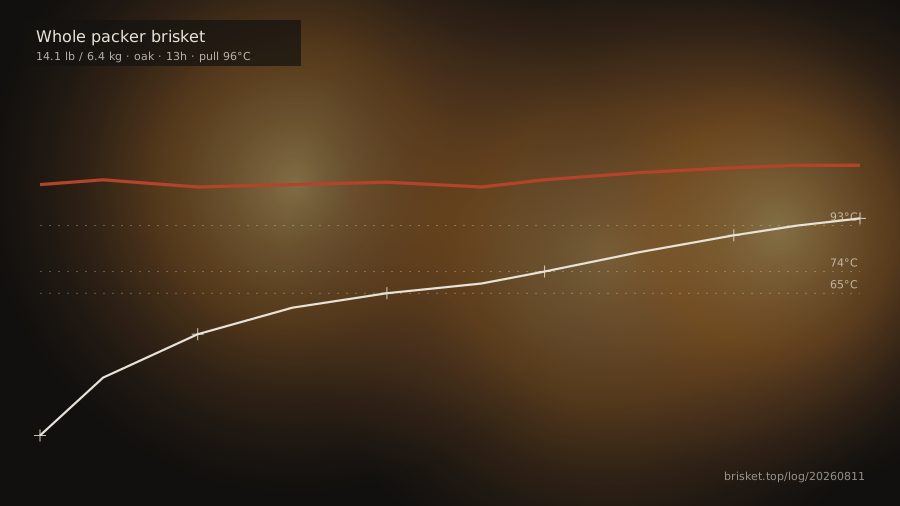
A 6.4 kg packer trimmed to 5.6 kg, cooked at 110°C over oak splits for 13 hours, wrapped in peach paper at 74°C internal and pulled at 96°C after a 2.5 hour rest. This is the baseline cook every other brisket entry on the ledger is measured against.
- Cook date8 Aug 2026
- Published11 Aug 2026
- Raw weight14.1 lb / 6.4 kg
- WoodOak
- CookerOffset stick burner
Cook timeline
- 04:40 Brisket on, fat side up, probe in the thickest part of the flat Lit the fire 30 minutes earlier with three oak splits over half a chimney of lump Pit110°C Internal6°C +0m
- 05:40 First split added, intake quarter open Surface hit 30°C fast; this is the evaporation phase, not cooking yet Pit112°C Internal30°C +1h
- 07:10 Misted the flat with water, closed the intake a notch Pit was drifting up on the wind; the bark had set enough to take a spray Pit109°C Internal48°C +2h30
- 08:40 Split 4 and 5 in, ash drawer emptied Ash build-up under the grate is what makes an offset run cold at hour four Pit110°C Internal59°C +4h
- 10:10 Stall confirmed, nothing changed Two consecutive reads inside 1°C at 111°C pit; do not chase it with heat Pit111°C Internal65°C +5h30
- 11:40 Third hour of the stall, wrapped nothing yet 69°C after 90 minutes is normal for a 6.4 kg packer at 110°C Pit109°C Internal69°C +7h
- 12:40 Wrapped in peach butcher paper, fat side down Paper rather than foil: it lets the last of the steam out and keeps the bark from steaming soft Pit112°C Internal74°C +8h
- 14:10 Raised the pit 3°C to push through the last stretch Once wrapped, the meat is insulated enough to take a hotter chamber Pit115°C Internal82°C +9h30
- 15:40 Probe check every 30 minutes from here Between 89 and 96°C the collagen window is thin; 40 minutes is the difference between tender and crumbly Pit117°C Internal89°C +11h
- 16:40 Tightened the wrap, kept going Probe slid in with slight resistance at the flat — not ready Pit118°C Internal93°C +12h
- 17:40 Pulled, vented the paper for 12 minutes, then into a cooler Probe went in like warm butter in the point and with almost no resistance in the flat Pit118°C Internal96°C +13h
Trimming and the weight that actually matters
The packer came out of the bag at 6.4 kg and went on the grate at 5.6 kg. That 800 g is mostly the hard fat cap between the point and the flat, plus the grey exterior fat that never renders and just sits there as a rubbery band in the slice.
I trim the fat cap to roughly 6 mm, not to bare meat. Below 4 mm the flat dries out on the side facing the firebox; above 10 mm the fat insulates the meat from the chamber and stretches the cook by an hour for no benefit.
| Item | Weight | Kept |
|---|---|---|
| Weight in the bag | 6.40 kg | — |
| Hard deckle fat removed | 0.44 kg | discarded |
| Grey exterior fat and silver skin | 0.21 kg | discarded |
| Trimmed flat edge (for sausage) | 0.15 kg | saved |
| Weight on the grate | 5.60 kg | — |
Rub and the dry brine window
The rub is coarse black pepper, kosher salt and a little granulated garlic, in a 3:2:0.5 ratio by volume, with no sugar. Sugar on a 13-hour cook at 110°C does nothing except darken the bark early and make it taste bitter at the thin end of the flat.
It went on 14 hours before the fire was lit and sat uncovered in the fridge. That is long enough for the salt to pull moisture out and draw it back in with the pepper, which is what gives the bark its grip. Two hours before the cook would have been seasoning, not brining.
- Coarse black pepper: 4 tablespoons
- Kosher salt: 2.5 tablespoons (about 1.1% of the trimmed weight)
- Granulated garlic: 1 teaspoon
- No sugar, no paprika, no binder
Running an offset without chasing the dial
The pit held between 108°C and 118°C for the whole cook. A 10°C band is fine for brisket. What is not fine is a pit that swings 40°C every time a split catches, because the surface of the meat dries and re-wets repeatedly and the bark ends up brittle.
The rule I use is one split every 40 to 50 minutes, pre-heated on top of the firebox so it ignites in seconds rather than smouldering. Splits go in with the intake already open a quarter turn, and the intake comes back down two minutes later once the new wood has caught. That keeps the rebound small.
- Nine oak splits over 13 hours, each roughly 30 cm long and 8 cm across
- Intake never more than half open; the chimney damper stayed fully open throughout
- Ash drawer emptied at hour four — an offset that suddenly runs cold at hour four is usually sitting on its own ash
- Lid opened four times in 13 hours, twice to wrap and check
Stall, wrap and the 2.5 hour rest
The stall started at 65°C and lasted almost three hours, which for a packer this size at this pit temperature is textbook. I wrapped at 74°C in peach paper rather than foil. Foil would have pushed the cook through 45 minutes faster and left the bark soft and grey.
The rest is the part people skip. Two and a half hours in a dry cooler, wrapped in a towel, brought the internal temperature down to 52°C before slicing — still well above the 60°C window you would want for a hot serve if you were holding it for guests, but it let the fibres relax enough to hold their shape on the board.
| Stage | Reading | Clock |
|---|---|---|
| On the grate | 6°C internal | 04:40 |
| Stall begins | 65°C | 10:10 |
| Wrapped (peach paper) | 74°C | 12:40 |
| Pulled | 96°C | 17:40 |
| Out of the cooler | 52°C | 20:10 |
Cross-section notes
The flat end that sat nearest the firebox came out with a 7 mm smoke ring and a tighter, slightly dry crumb; the point behind it was soft enough to pull apart with two fingers. Fat rendered to a translucent amber, roughly 6 mm left on top. The grain in the flat runs at about 15° to the long axis, so a single straight cut across the whole packer will partly go with the grain in the point.
- Stall
- 68°C
- Wrap method
- Peach butcher paper
- Wrapped at
- 8h 00m
- Pulled at
- 96°C
- Rest
- 2h 30m
- Score
- 4.5/5
Verdict: Pulling at 96°C rather than the 93°C I used all last year gave a noticeably softer point without drying the flat, but only because it rested 2.5 hours. At 96°C with a 45-minute rest the same cook would have been crumbly.
Adjacent entries
 21 Aug 2026
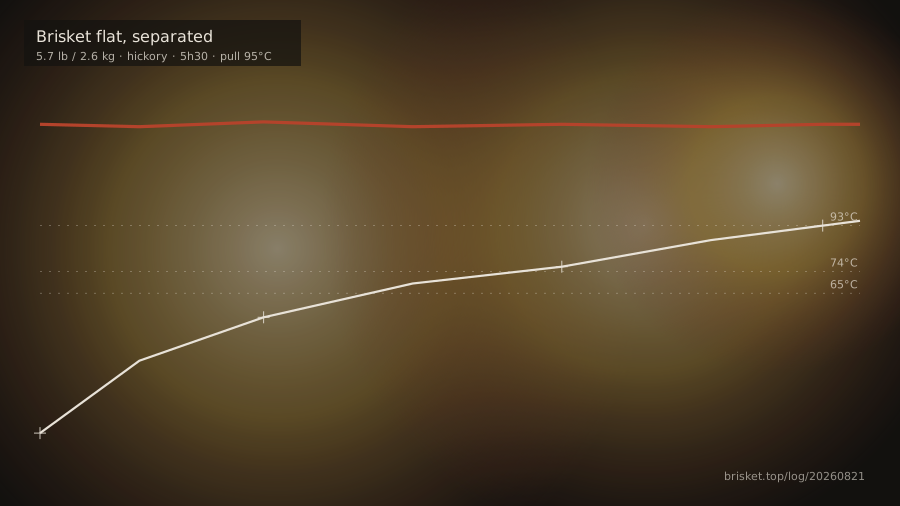
Brisket flat, separated
Hickory
Insulated cabinet
5.7 lb / 2.6 kg
Even slice, faint smoke ring, no bark crunch4/5
21 Aug 2026
Brisket flat, separated
Hickory
Insulated cabinet
5.7 lb / 2.6 kg
Even slice, faint smoke ring, no bark crunch4/5
 21 Sep 2026
Whole packer brisket, dry brined 48 hours
Pecan
Gravity-fed charcoal
13.0 lb / 5.9 kg
Best flat texture of the year, bark a shade pale4.8/5
21 Sep 2026
Whole packer brisket, dry brined 48 hours
Pecan
Gravity-fed charcoal
13.0 lb / 5.9 kg
Best flat texture of the year, bark a shade pale4.8/5