Whole skin-on pork belly · 7.1 lb / 3.2 kg · Kettle with snake
Whole skin-on pork belly over a kettle snake
A 3.2 kg slab of skin-on belly, scored at 1 cm, cooked indirect over a briquette snake at 130°C for seven hours and finished hot to get the skin to crackle. Two textures in one piece, and they do not want the same treatment.
- Cook date19 Aug 2026
- Published23 Aug 2026
- Raw weight7.1 lb / 3.2 kg
- WoodCherry
- CookerKettle with snake
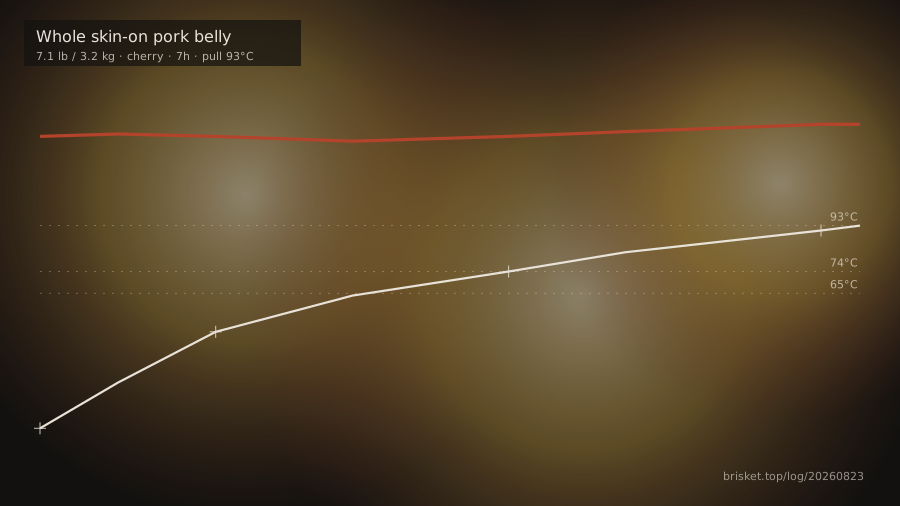
Cook timeline
- 10:00 Belly on, skin up, indirect over a two-zone kettle Snake of 2x2 briquettes around the rim, 12 lit at one end Pit130°C Internal9°C +0m
- 10:40 Scored the skin again, 1 cm squares Second scoring opens cuts that closed up as the skin tightened Pit131°C Internal28°C +40m
- 11:30 Rotated 180° Kettle runs 15°C hotter over the lit end of the snake Pit130°C Internal49°C +1h30
- 12:40 Added 8 briquettes to the snake One fuel top-up for the whole cook Pit128°C Internal64°C +2h40
- 14:00 Skin brushed with oil Oil on the skin at this stage is what gets it to crackle rather than chew Pit130°C Internal74°C +4h
- 15:00 Moved into a half pan, uncovered, skin up A pan, not a wrap: the skin must keep facing dry heat Pit132°C Internal82°C +5h
- 16:40 Raised the kettle to 135°C for the skin The lean layer was already past where it wanted to be Pit135°C Internal91°C +6h40
- 17:00 Pulled, rested 40 minutes uncovered Never cover belly — trapped steam turns crackling back into leather Pit135°C Internal93°C +7h
Scoring, salting and drying the skin
The skin was scored at 1 cm in both directions, cutting through the skin and the fat beneath but stopping at the lean. Cut into the lean and the juices run out of the slab and onto the coals, which is where the flare comes from and why people think belly is difficult.
Then it was salted heavily and left uncovered in the fridge for 24 hours. That dries the skin surface, and a dry skin is the only skin that crackles. Belly taken straight from the pack to the kettle will always have a chewy skin, no matter what temperature you finish it at.
- Score at 1 cm, through skin and fat, stopping at the lean
- Kosher salt at 1.5% of the slab weight, applied 24 hours ahead
- Leave uncovered in the fridge — a covered belly stays wet and will not crackle
- Pat dry again immediately before it goes on, and brush the skin with a neutral oil at hour four
Two-zone cooking on a kettle
A 2x2 snake of briquettes round the rim, twelve lit at one end, gives 130°C at the grate with the lid on and needs one top-up in seven hours. The belly sat over the unlit side, skin up, with a drip tray underneath to keep the coals from flaring.
The kettle runs about 15°C hotter over the lit end of the snake, so a 180° rotation at the halfway point is worth doing on anything that takes more than four hours.
| Hour | Briquettes lit | Grate temperature | Action |
|---|---|---|---|
| 0 | 12 of 48 | 130°C | Belly on, skin up, indirect |
| 1.5 | — | 130°C | Rotate 180° |
| 2.7 | 8 lit added | 128°C | Fuel top-up |
| 4 | — | 130°C | Oil the skin |
| 6.7 | — | 135°C | Vents open for the finish |
The problem with cooking one slab at one temperature
Skin needs about 82°C and dry heat to puff and crackle. The lean layer inside a belly wants to come off at 88°C or it goes dry. In this cook the lean hit 88°C at hour five and the skin was still chewy, so the slab stayed on for another two hours and the lean went to 93°C.
The result is visible in the slice: crisp skin, then a lean band that reads dry, then soft fat and a moist centre. The fix is either to finish the skin separately under a grill for the last ten minutes, or to accept a softer crackling and pull the whole slab at 88°C.
| Layer | Target | Reached at | Result here |
|---|---|---|---|
| Skin (crackling) | 82°C, dry heat | not until 17:00 | Crisp, good |
| Lean band | 88°C | hour 5 | Pushed to 93°C, dry |
| Fat layers | rendered, not collapsed | hour 4 | Set but not oily |
| Centre | tender | hour 6 | Soft, correct |
Cutting and serving belly
Cut straight down through a scored belly and every slice is mostly fat with a thin lean streak, which is why people find it rich. Cut on a 45° bias and each slice crosses three or four of the score lines, so every piece carries skin, fat and lean in the same bite. It is a two-minute difference in the kitchen that changes the whole plate.
Serve it in 1 cm slices with something acidic — pickled mustard seed, a vinegary slaw, or just hot sauce. Anything sweet makes it heavy.
- Bias cut at 45°, 1 cm thick, across the original score lines
- Never cover the slab while resting
- Reheat slices in a dry pan, skin side down, 3 minutes — never in a microwave
- Leftover fat trimmings render down for roasting potatoes
Cross-section notes
Belly is roughly 42% fat, and the fat does not render away — it stays and keeps the meat under it cooking long after the collagen has converted. The bands in the cross-section alternate: crisp skin, 8 mm of set fat, a thin lean layer that reads dry, then more fat, then a soft centre. That alternating structure is why bias-cutting at 45° matters so much here.
- Stall
- 76°C
- Wrap method
- Half pan with tight foil lid
- Wrapped at
- 5h 00m
- Pulled at
- 93°C
- Rest
- 40m
- Score
- 4.3/5
Verdict: Two cooks in one piece of meat and they finished 40 minutes apart. The skin needed 82°C and dry heat; the lean needed to come off at 88°C. Cooking belly whole at one temperature means one of them is always wrong.
Adjacent entries
 13 Aug 2026
Bone-in pork butt
Apple
Bullet water smoker
9.0 lb / 4.1 kg
Bone slid out clean, bark stayed crisp through the wrap4.7/5
13 Aug 2026
Bone-in pork butt
Apple
Bullet water smoker
9.0 lb / 4.1 kg
Bone slid out clean, bark stayed crisp through the wrap4.7/5
 14 Sep 2026
Whole chicken, spatchcocked
Cherry
Kettle with snake
4.0 lb / 1.8 kg
Skin crisp all over, breast at 74°C and legs at 82°C at the same time4.7/5
14 Sep 2026
Whole chicken, spatchcocked
Cherry
Kettle with snake
4.0 lb / 1.8 kg
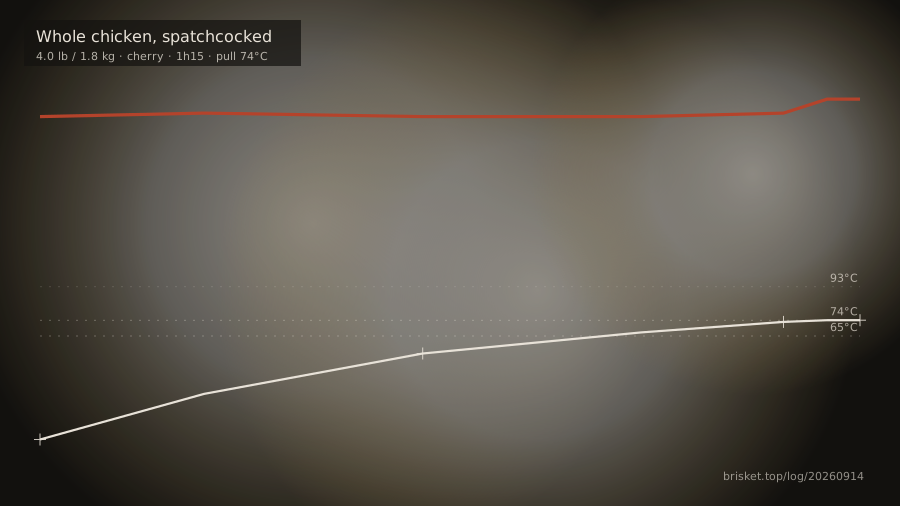
Skin crisp all over, breast at 74°C and legs at 82°C at the same time4.7/5