Full spare ribs, untrimmed · 5.1 lb / 2.3 kg · Bullet water smoker
Full spare ribs and an honest look at three-two-one
A 2.3 kg untrimmed spare rack cooked by the standard 3-2-1 method at 110°C: three hours bare, two hours wrapped, one hour sauced. It produced textbook fall-off-the-bone ribs, which for ribs is not a compliment.
- Cook date4 Sep 2026
- Published8 Sep 2026
- Raw weight5.1 lb / 2.3 kg
- WoodCherry
- CookerBullet water smoker
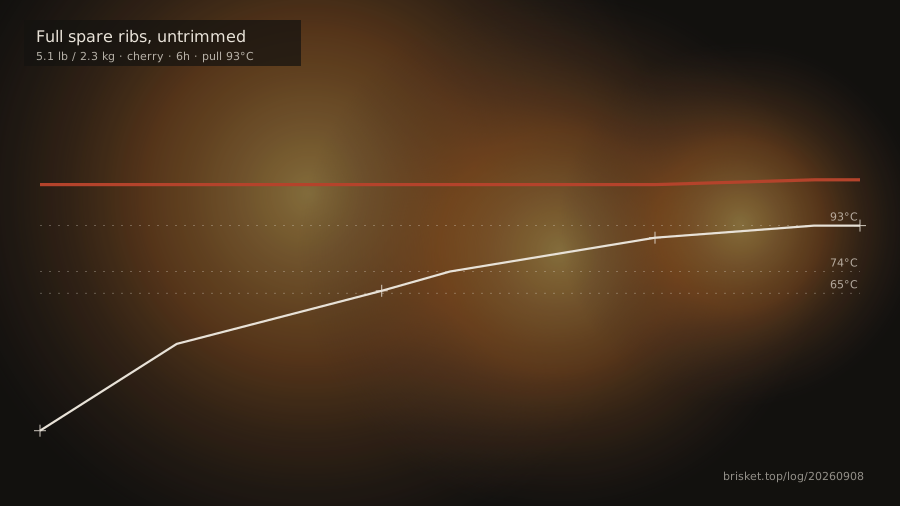
Cook timeline
- 11:00 Rack on, bone side down, membrane removed Membrane off, but the skirt and the brisket bone left on — this is an untrimmed spare Pit110°C Internal8°C +0m
- 12:00 Nothing done, no spritz Cherry colours fast; the rack is already deep red at one hour Pit110°C Internal44°C +1h
- 13:30 Started checking the bend The bend test on ribs is worth more than any thermometer reading Pit110°C Internal66°C +2h30
- 14:00 Wrapped in foil with 30 ml apple juice This is the two in 3-2-1, and it is the phase that does the damage on thin racks Pit110°C Internal74°C +3h
- 15:30 Unwrapped, back on the grate The bark had gone soft; the sauce stage is meant to rebuild it, and it does not Pit110°C Internal88°C +4h30
- 16:40 Sauced and returned for 20 minutes Sugar in the sauce sets at about 110°C; longer than 20 minutes and it burns Pit112°C Internal93°C +5h40
- 17:00 Pulled, rested 30 minutes, sliced one bone at a time The bones came away clean with no meat attached — the tell Pit112°C Internal93°C +6h
What 3-2-1 actually is
Three hours bare at 110°C, two hours wrapped with a splash of liquid, one hour back on the grate with sauce. It was written for a full spare rack of about 2.5 kg cooked at 110°C, which is exactly what this cook was, and it still overshot.
The reason is that 3-2-1 is a schedule, not a method: it has no feedback loop. A rack that needed two and a half hours of smoke got three, and a rack that needed forty minutes wrapped got a hundred and twenty.
| Phase | 3-2-1 | This rack | Difference |
|---|---|---|---|
| Bare smoke | 3 h 00 m | 2 h 30 m | −30 m |
| Wrapped | 2 h 00 m | 1 h 15 m | −45 m |
| Sauce | 1 h 00 m | 0 h 20 m | −40 m |
| Total | 6 h 00 m | 4 h 05 m | −1 h 55 m |
The bend test, and the one thing it tells you
Pick the rack up with tongs at one end, about a third of the way along. A rack that is ready bows so that the surface cracks slightly across the top and the meat at the bend feels like it is about to give. A rack that is not ready stays flat and rigid.
This test has a failure mode in each direction. Underdone ribs are chewy and the meat does not come off the bone at all. Overdone ribs come off the bone entirely, which is where this cook landed. The window is about twenty minutes wide at 110°C.
- Lift with tongs at the one-third point; a ready rack cracks across the surface
- The bone should rotate slightly in the meat, not slide out
- A toothpick between the bones should meet light resistance, not none
- Fall-off-the-bone is the failure state, not the goal
The wrap is where the damage happens
Two hours in foil at 110°C steams the rack. Everything that made the bark firm — the dried surface, the set rub, the rendered fat — rehydrates and goes soft. The final sauced hour is supposed to rebuild it and it cannot, because the surface is now wet and the chamber is not hot enough to dry it out again before the sugar burns.
For racks under 2.5 kg, cut the wrap to forty-five minutes or skip it entirely. Foil is a tool for a stall, and ribs at 110°C have no stall — there is not enough mass.
| Rack weight | Wrap | Wrapped for | Texture |
|---|---|---|---|
| 1.1-1.5 kg (baby back) | None | — | Bite-through, clean bone |
| 1.8-2.4 kg (spare) | Foil | 40-50 min | Bite-through, slight tug |
| 2.4-3.0 kg (spare) | Foil | 1 h 00 m | Tender, bone releases |
| This cook (2.3 kg) | Foil | 2 h 00 m | Falls apart — over |
Saucing, resting and cutting
Sauce goes on for the last twenty minutes only, and it should be thin. A thick sauce at 112°C for an hour turns into a shellac layer that is sweet and hard. Twenty minutes is enough to set it and not enough to burn it.
Rest thirty minutes loose under foil, then cut from the bone side with a sharp knife, one bone per slice. On a spare rack, cut the brisket bone off first and serve it separately — it is a chewy, meaty strip that nobody at the table fights over, and leaving it on makes the rack look bigger than it is.
- Sauce in the last 20 minutes, thin, applied twice
- Rest 30 minutes loose under foil — never wrapped tight, or the bark steams off
- Cut bone-side-down, one bone per slice, knife straight down
- Skirt and brisket bone served separately or cut off before plating
Cross-section notes
The cross-section showed the meat had pulled back about 12 mm from the bone ends and the muscle had separated from the bone across its whole length. A rib that falls off the bone has been cooked past the point where the muscle fibres still hold together, and the texture in the mouth is closer to pot roast than to barbecue.
- Stall
- 0°C
- Wrap method
- Heavy foil
- Wrapped at
- 3h 00m
- Pulled at
- 93°C
- Rest
- 30m
- Score
- 3.9/5
Verdict: The 3-2-1 method works, and that is the problem: it works the same on a 1.2 kg rack and a 2.3 kg one, and it produces fall-off-the-bone ribs by design. For a rack this size, three hours of smoke then two hours wrapped is thirty minutes too long in each phase.
Adjacent entries
 11 Sep 2026
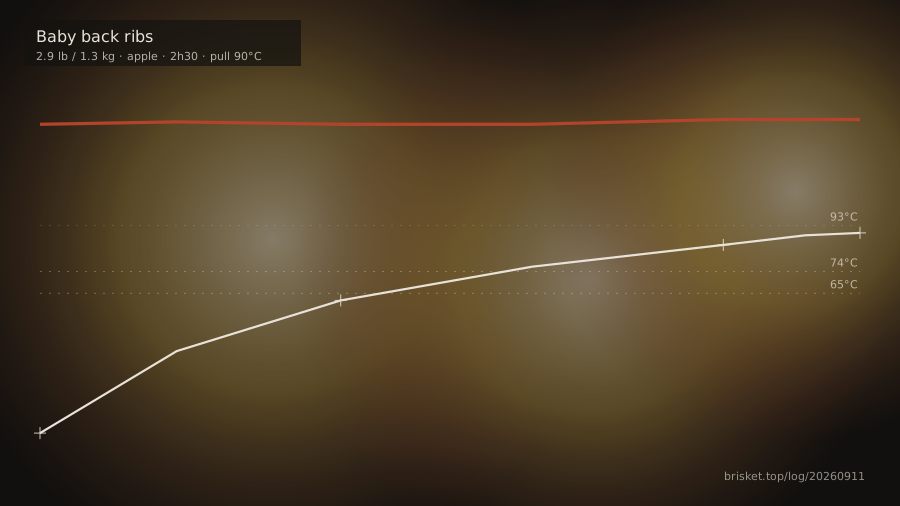
Baby back ribs
Apple
Kettle with snake
2.9 lb / 1.3 kg
Clean bite, bone bare, two and a half hours start to plate4.6/5
11 Sep 2026
Baby back ribs
Apple
Kettle with snake
2.9 lb / 1.3 kg
Clean bite, bone bare, two and a half hours start to plate4.6/5
 2 Sep 2026
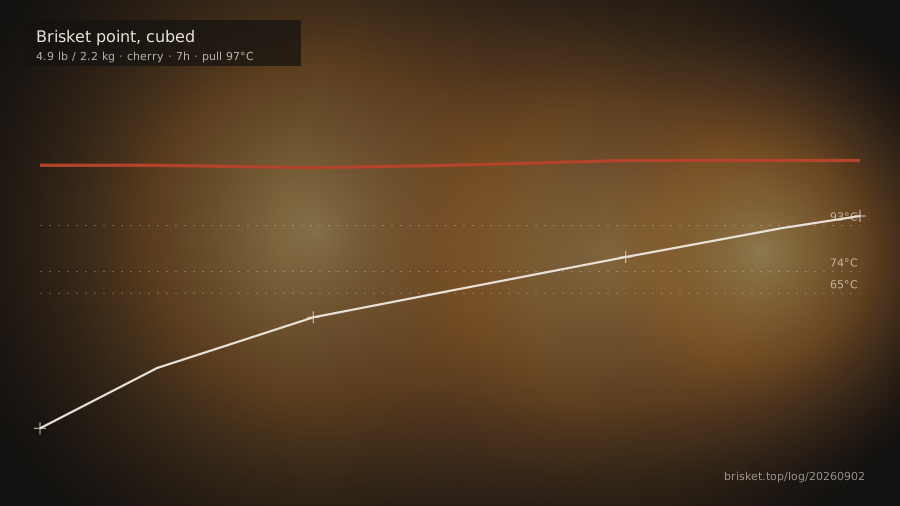
Brisket point, cubed
Cherry
Bullet water smoker
4.9 lb / 2.2 kg
Sticky, glossy cubes; sauce reduced further than intended4.5/5
2 Sep 2026
Brisket point, cubed
Cherry
Bullet water smoker
4.9 lb / 2.2 kg
Sticky, glossy cubes; sauce reduced further than intended4.5/5